
Introduction: Why Landing Pages Matter for Lead Generation
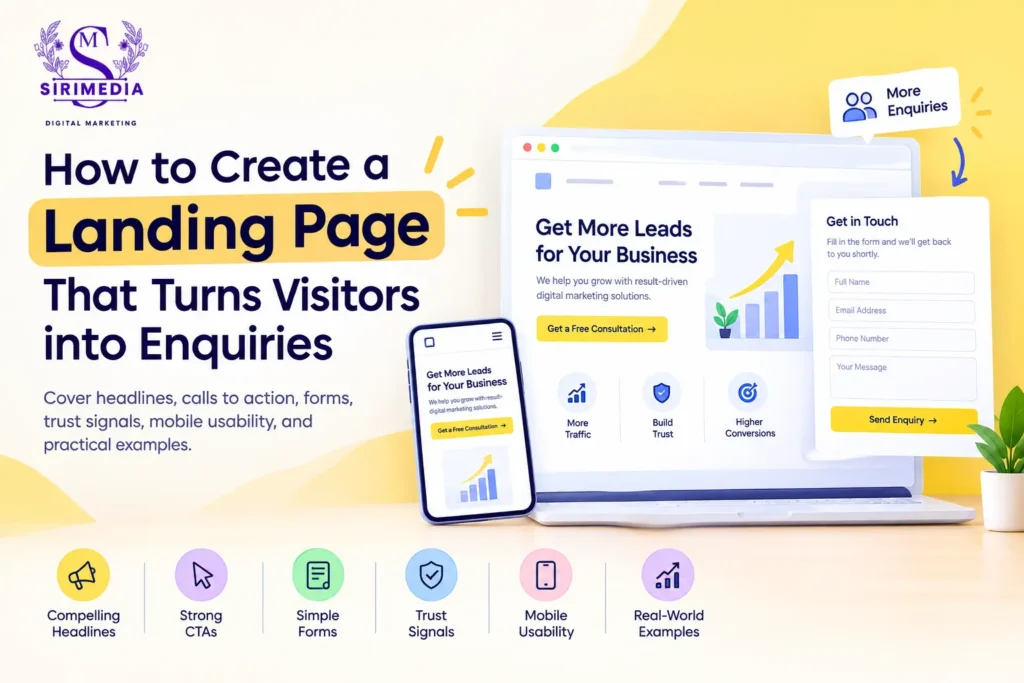
landing page for lead generation is one of the most effective ways to turn website visitors into potential customers when the page is designed around a specific conversion goal. Unlike a general website page, a landing page focuses the visitor’s attention on one offer, service, product, or action.
A well-designed landing page can help businesses generate enquiries, phone calls, form submissions, demo requests, quotation requests, and other valuable leads. However, simply creating a page is not enough. The headline, content, call-to-action, form, trust signals, images, and mobile experience all need to work together.
In this guide, we will explain how to create a landing page that encourages visitors to take action and become enquiries.
1. Start With One Clear Landing Page Goal
Before designing your landing page, decide exactly what you want visitors to do.
Choose One Primary Conversion
Your landing page should have one main objective, such as:
- Submit an enquiry form
- Request a free consultation
- Book a demo
- Request a quotation
- Call your business
- Download a resource
- Schedule an appointment
- Start a WhatsApp conversation
Having one primary goal makes the page easier to understand and reduces distractions.
Match the Page With Visitor Intent
The landing page should match the reason someone arrived on the page.
For example, if your advertisement promotes SEO services for small businesses, the landing page should immediately explain those SEO services instead of sending visitors to a generic homepage.
A strong connection between the advertisement, keyword, headline, and landing page can create a more consistent user experience.
2. Create a Headline That Gets Attention
The headline is one of the first things visitors see when they reach your landing page.
Make the Value Clear Immediately
Your headline should tell visitors what they can get and why it matters.
Instead of:
Digital Marketing Services
Try:
Generate More Qualified Enquiries With Data-Driven Digital Marketing
Or:
Get More Leads From Your Website With Conversion-Focused SEO
The second approach communicates a clearer benefit.
Use a Supporting Subheading
Your subheading can provide additional context without making the main headline too long.
For example:
H2: Generate More Enquiries From Your Website
Supporting text:
We create SEO-friendly landing pages designed to attract relevant visitors, build trust, and encourage more people to contact your business.
The combination of a strong headline and supporting statement helps visitors understand your offer quickly.
3. Write Conversion-Focused Landing Page Content
Good landing page content should answer the questions visitors have before they decide to enquire.
Explain the Problem
Start by showing that you understand the visitor’s situation.
For example:
Getting website traffic is valuable, but traffic alone does not guarantee enquiries. If visitors leave without contacting your business, your website may need a stronger conversion strategy.
This makes the content relevant to the visitor’s problem.
Present Your Solution
After identifying the problem, explain how your product or service addresses it.
Focus on benefits rather than simply listing features.
Instead of:
- SEO audit
- Keyword research
- Website optimization
- Content creation
You could explain:
- Identify opportunities to attract relevant search traffic
- Improve visibility for valuable keywords
- Create content that answers customer questions
- Optimize pages to encourage enquiries
This makes the service easier to understand.
4. Use Strong Calls to Action
A call to action (CTA) tells visitors what to do next.
Examples of Effective CTAs
Depending on your business, you can use:
- Get a Free Quote
- Request a Consultation
- Get Your Free Audit
- Book a Demo
- Talk to Our Team
- Request More Information
- Start Your Project
- Get Started Today
Your CTA should clearly communicate the next step.
Make the CTA Easy to Find
Don’t hide the CTA at the bottom of a long page.
Consider placing CTAs:
- In the hero section
- After explaining your solution
- After trust signals or testimonials
- Near the enquiry form
- At the bottom of the page
However, avoid filling every section with multiple competing buttons. The CTA should feel natural and consistent.
5. Build a Simple Enquiry Form
Your form is one of the most important elements of a lead-generation landing page.
Ask Only for Necessary Information
A complicated form can discourage visitors from completing it.
For many businesses, a simple form could include:
- Name
- Phone number
- Email address
- Business name
- Service required
- Message
You can add additional fields when they are genuinely necessary for qualifying leads.
Use Clear Form Labels
Avoid unclear fields such as:
Enter details
Instead, use specific labels such as:
Full Name
Business Name
Phone Number
Email Address
How can we help?
Visitors should understand exactly what information you need.
Make the Submit Button Specific
Instead of using a generic Submit, consider:
Request My Free Consultation
or:
Send Enquiry
A descriptive button can make the next step clearer.
6. Add Trust Signals to Reduce Doubts
Visitors may be interested in your offer but still hesitate because they don’t know whether they can trust your business.
Trust signals can help address those concerns.
Use Testimonials
Add genuine customer testimonials that explain the customer’s experience.
For example:
“The team helped us improve our online visibility and generate more relevant enquiries.”
Whenever possible, include the customer’s name, business, location, or other appropriate context with permission.
Showcase Results and Case Studies
If you have documented results, present them clearly.
A case study can follow this structure:
Challenge → Strategy → Execution → Result
For example:
Challenge: Low website visibility
Strategy: Local SEO and content optimization
Execution: Keyword research, technical SEO and location-focused content
Result: Increased organic visibility and qualified enquiries
Only use results that you can genuinely support.
Include Business Credentials
Depending on your business, you can display:
- Years of experience
- Certifications
- Industry memberships
- Client logos
- Reviews
- Awards
- Number of projects completed
- Service guarantees, where genuinely offered
These elements can provide additional context for visitors evaluating your business.
7. Explain Your Services or Offer Clearly
Visitors should understand exactly what they are enquiring about.
Use Benefit-Focused Service Cards
For example:
SEO Optimization
Improve your website’s visibility for relevant search queries and attract potential customers searching for your services.
Landing Page Design
Create focused pages that communicate your offer clearly and guide visitors toward an enquiry.
Conversion Optimization
Identify friction points and improve page elements that influence visitor actions.
Keep service descriptions short and focused. The landing page is not the place to overwhelm visitors with excessive information.
8. Use Visuals That Support the Message
Images and graphics can make a landing page more engaging, but every visual should have a purpose.
Choose Relevant Images
For a digital marketing landing page, you could use:
- Website interface screenshots
- Analytics dashboards
- Conversion illustrations
- Professional team photographs
- Product or service images
- Before-and-after examples
- Case study visuals
Avoid using unrelated stock images simply to fill empty space.
Use Visual Hierarchy
Your design should naturally guide visitors through:
Headline → Benefit → Proof → Solution → CTA → Form
Whitespace, typography, icons, images, and section spacing can all help create this visual flow.
9. Make the Landing Page Mobile-Friendly
A large percentage of visitors may access your landing page from smartphones.
Use Responsive Design
Your page should work smoothly across:
- Smartphones
- Tablets
- Laptops
- Desktop computers
Text should remain readable without zooming, buttons should be easy to tap, and forms should work properly on smaller screens.
Make Mobile CTAs Easy to Tap
Buttons should have enough spacing and should not be placed too close together.
For mobile users, consider useful actions such as:
- Call Now
- Send Enquiry
- WhatsApp Us
- Request a Quote
The appropriate option depends on how your customers normally contact your business.
10. Improve Landing Page Loading Speed
A beautiful landing page will not perform well if it takes too long to load.
Optimize Images
Large image files can slow down your website.
Consider:
- Compressing images
- Using modern image formats
- Choosing appropriate dimensions
- Avoiding unnecessary background videos
- Lazy-loading images where appropriate
Reduce Unnecessary Elements
Remove scripts, animations, plugins, widgets, and design elements that do not contribute to the visitor’s goal.
A cleaner page can provide a faster and more focused experience.
11. Use SEO-Friendly Landing Page Structure
Although landing pages are often created for advertising and campaigns, SEO can also be considered when the page is intended to attract organic search traffic.
Use a Clear Heading Structure
A basic structure could be:
H1: Main landing page topic
H2: The Problem
H2: Our Solution
H2: Services or Features
H2: Why Choose Us
H2: Customer Results
H2: Frequently Asked Questions
H2: Request a Consultation
Use H3 headings underneath H2 sections when you need to divide the content further.
For example:
H2: Why Choose Our Digital Marketing Services
H3: SEO Strategy
H3: Content Marketing
H3: Conversion Optimization
This creates a logical structure for both users and search engines.
Include the Focus Keyword Naturally
If your target keyword is landing page for lead generation, use it naturally in important locations such as:
- SEO title
- H1 or relevant heading
- Introduction
- One or more H2/H3 sections where appropriate
- Body content
- Image alt text when genuinely descriptive
- Meta description
Avoid repeating the keyword unnaturally. Keyword stuffing can make content difficult to read.
12. Add a Frequently Asked Questions Section
FAQs can address common objections before visitors contact you.
What Is a Landing Page for Lead Generation?
A landing page for lead generation is a focused webpage designed to encourage visitors to provide their contact information or take another valuable action.
What Should a Lead Generation Landing Page Include?
A typical page can include a strong headline, clear offer, benefits, CTA, enquiry form, trust signals, testimonials, FAQs, and relevant visuals.
How Long Should a Landing Page Be?
There is no universal ideal length. The page should contain enough information to answer the visitor’s important questions and support the conversion goal without unnecessary content.
Should a Landing Page Have Navigation?
It depends on the purpose of the page. Campaign-focused landing pages often minimize distractions, while SEO-focused pages may use more traditional website navigation.
13. Track Your Landing Page Conversions
Creating a landing page is only the beginning. You should also measure what visitors do on the page.
Track Important Events
Depending on your setup, you can track actions such as:
- Page views
- Form submissions
- Button clicks
- Phone calls
- WhatsApp clicks
- Purchases
- Downloads
- Appointment bookings
Tracking helps you understand whether the page is generating the actions you actually want.
Measure Conversion Rate
A simple conversion-rate calculation is:
Conversion Rate = Conversions ÷ Visitors × 100
For example, if 1,000 visitors arrive on a page and 50 complete an enquiry form:
50 ÷ 1,000 × 100 = 5%
This gives you a useful starting point for evaluating page performance.
14. Practical Landing Page Example
Imagine a local business wants more enquiries for its website development service.
Hero Section
H1: Get a Website That Helps Your Business Generate More Enquiries
Supporting text:
We design fast, responsive and SEO-friendly websites that help businesses attract visitors and turn them into potential customers.
CTA: Get a Free Consultation
Problem Section
H2: Is Your Website Getting Visitors but Not Enough Enquiries?
Explain common problems such as unclear messaging, weak CTAs, complicated forms, poor mobile usability, and lack of trust signals.
Solution Section
H2: Everything Your Website Needs to Convert Visitors
Conversion-Focused Design
Clear layouts designed around the visitor journey.
Mobile-Friendly Experience
Responsive pages that work across smartphones, tablets and desktops.
Strong Calls to Action
Strategically placed CTAs that guide visitors toward the next step.
Enquiry Forms
Simple forms designed to make contacting your business easy.
Trust Section
H2: Why Businesses Choose Us
Include genuine testimonials, case studies, credentials, client logos, or documented results.
Final CTA
H2: Ready to Turn More Visitors Into Enquiries?
Let’s create a landing page that clearly communicates your offer and makes it easier for potential customers to contact you.
CTA: Request a Free Consultation
15. Landing Page Conversion Checklist
Before publishing your landing page, check the following:
Content
- Clear H1
- Strong value proposition
- Relevant supporting content
- Benefits explained clearly
- No unnecessary information
Conversion Elements
- Clear CTA
- Simple inquiry form
- Visible contact options
- Trust signals
- Testimonials or case studies
- FAQ section
Technical SEO
- SEO title
- Meta description
- One clear H1
- Proper H2 and H3 hierarchy
- Descriptive image alt text
- Mobile responsive design
- Fast loading speed
- Analytics and conversion tracking
Conclusion
A successful landing page for lead generation should do more than look professional. It should communicate the value of your offer, answer visitor questions, build trust, remove unnecessary friction, and make the next step obvious.
Start with one clear goal, create a compelling headline, explain the benefits, add a simple enquiry form, use genuine trust signals, optimize the page for mobile users, and track important conversions.
Most importantly, keep testing your landing page. Small improvements to headlines, CTAs, forms, page structure, and messaging can help you understand what encourages your target audience to take action.
A landing page should not simply attract visitors—it should guide the right visitors toward becoming enquiries.