
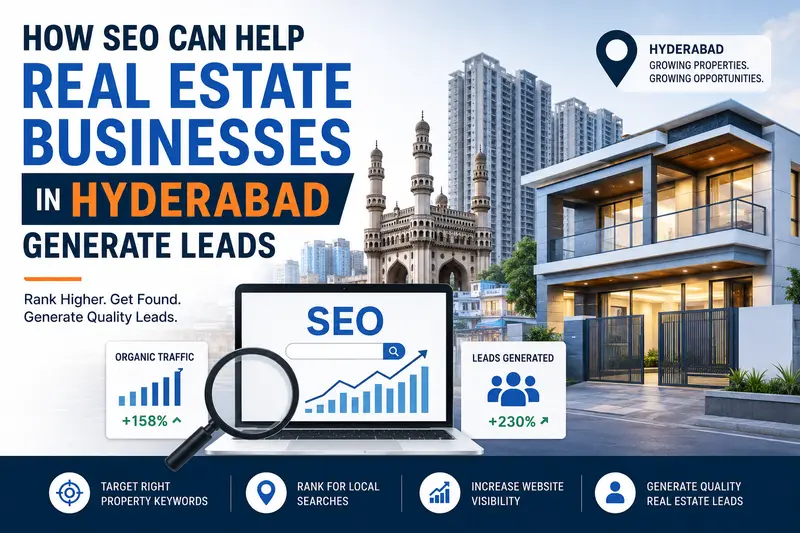
How to generate leads in real estate is one of the biggest questions facing builders, property developers, brokers, channel partners, and real estate consultants in Hyderabad. Buyers no longer depend only on newspaper advertisements, roadside banners, or personal referrals when they want to purchase a flat, villa, plot, or commercial property. They search online, compare locations, check prices, read reviews, watch property videos, investigate developers, and often contact a business only after several digital interactions. That shift makes real estate SEO Hyderabad a powerful long-term strategy for businesses that want a consistent flow of potential buyers. Hyderabad’s housing market continues to show substantial activity: reports published in August 2026 said the city recorded residential sales worth about ₹52,913 crore during H1 2026, with nearly 60 million square feet sold. When thousands of buyers are actively researching properties, appearing at the exact moment they search for relevant information can become a major competitive advantage. SEO essentially helps your business become visible before your competitors get the opportunity to speak to the customer.
Why SEO Matters for Hyderabad Real Estate Businesses
Real estate is different from many everyday purchases because customers rarely make a decision after seeing one advertisement. Someone looking for a home in Gachibowli may first search for apartments in Gachibowli, then compare projects in Kondapur, investigate schools and hospitals nearby, check commute times to HITEC City, compare prices per square foot, search for reviews, and finally contact a developer or broker. Every one of these searches represents an opportunity to become visible. SEO allows a real estate business to build visibility across this entire decision journey instead of depending on a single advertisement. Hyderabad’s market is particularly suitable for this approach because demand is spread across many micro-markets and buyer categories, including apartments, villas, plots, luxury homes, gated communities, commercial properties, and investment opportunities. Current market reports also indicate that technology, GCC, BFSI, and professional-services employment continue to support housing demand in the city. For a real estate company, that means the goal should not simply be to rank for one broad term such as “real estate Hyderabad”; the goal should be to appear for hundreds of specific searches that reveal what different buyers actually want.
How to Generate Leads in Real Estate Through Google Search
How to generate leads in real estate becomes much easier when your website targets searches with genuine buying intent rather than chasing traffic for its own sake. Imagine a buyer searching “3 BHK apartments for sale in Kokapet” compared with someone searching “Hyderabad real estate news”. Both searches may generate visitors, but the first person has a much stronger commercial intention. A well-structured SEO campaign identifies these high-intent searches and creates pages that answer them directly. You can target phrases such as “flats for sale in Gachibowli”, “villas for sale in Kokapet”, “apartments near the Financial District, Hyderabad”, “open plots near ORR”, and “luxury apartments in Hyderabad” and highly specific combinations involving budget, configuration, location, and amenities. The purpose is not to stuff these phrases repeatedly into a page. Instead, each keyword should guide a useful page that helps the buyer make a decision and gives them a clear next step such as booking a site visit, requesting the price list, downloading a brochure, calling the sales team, or starting a WhatsApp conversation.
Understanding Real Estate SEO Hyderabad
Real estate SEO Hyderabad is the process of optimising a real estate company’s website, local presence, content, project pages, technical structure, and authority so that relevant Hyderabad property searches can discover the business through organic search. It combines traditional SEO with local SEO and real estate-specific search intent. A developer might need project pages, location pages, floor-plan information, amenities, possession details, legal information, FAQs, and buyer guides. A broker may need locality pages, property-category pages, buyer resources, and individual listings. A real estate consultant may focus more heavily on informational content, investment guides, property comparisons, and lead-generation landing pages. The important point is that the strategy must match the business model. A website selling premium villas in Kokapet should not use exactly the same SEO architecture as a broker specialising in affordable apartments across Hyderabad. Strong SEO starts by understanding who the buyer is, what they search for, where they are searching, and what information they need before contacting the business.
Target High-Intent Property Keywords
Keyword research should be treated as a map of buyer demand rather than a simple list of phrases. Start with broad commercial keywords and then move into longer, more specific searches. For example, “flats in Hyderabad” is broad, while “3 BHK flats for sale in Gachibowli under ₹1.5 core” expresses a much clearer requirement. Long-tail searches often have fewer searches individually, but collectively they can attract highly relevant visitors because they contain details about location, property type, budget, configuration, or purpose. Build keyword groups around apartments, villas, plots, commercial properties, luxury properties, new projects, ready-to-move properties, investment properties, and rental properties. Then create supporting keyword groups around locations such as Gachibowli, Kokapet, Kondapur, Financial District, Narsingi, Tellapur, Miyapur, Bachupally, Kompally, Uppal, and other areas relevant to your inventory. The result should be a logical content structure where every important search has an appropriate page rather than dozens of nearly identical pages competing with one another.
Use Location-Based Keywords
Location is one of the strongest signals in real estate search because buyers rarely search for property without considering where they want to live or invest. A buyer may search for “apartments near HITEC City”, “villas in Narsingi”, “plots near Shankarpally”, or “2 BHK flats in “Miyapur”””. “Shankarpally”. This gives real estate companies an opportunity to build neighbourhood-specific pages that provide genuine local information instead of simply replacing the location name in the same paragraph. A useful location page can discuss connectivity, nearby employment hubs, schools, hospitals, shopping areas, public transportation, typical property types, buyer profiles, and important considerations before purchasing. Current Hyderabad market commentary continues to highlight strong activity in western corridors and growing demand around areas connected to major employment centres. When your content demonstrates actual understanding of a locality, it can be much more useful to both search engines and prospective buyers than a thin page created only to target a keyword.
Build a High-Converting Real Estate Website
SEO can bring visitors to your website, but the website must convince those visitors to become leads. A beautiful homepage alone is not enough. A property buyer should be able to understand what you sell, where you operate, which projects are available, what the approximate price range is, what makes each project different, and how to contact you without searching through several pages. Your website should load quickly on mobile devices, because many property searches begin on smartphones. Project pages should contain strong photographs, floor plans where appropriate, amenities, location information, frequently asked questions, relevant documentation, and prominent calls to action. Instead of hiding contact information at the bottom of the page, consider placing useful conversion options throughout the buyer journey. A visitor who is not ready to call may still be willing to request a brochure or receive project details on WhatsApp. SEO and conversion optimisation should therefore work together: ranking creates the opportunity, while the website turns that opportunity into a measurable lead.
Create Property and Project Landing Pages
Every important project should ideally have a dedicated, optimised landing page rather than being buried inside a generic property listing section. The page should clearly communicate the project’s location, property type, configuration, value proposition, amenities, connectivity, developer information, and available buyer actions. Search engines need clear signals about what the page is actually about, while buyers need enough information to decide whether contacting the sales team is worthwhile. Avoid copying the same description across multiple project pages because duplicate or near-duplicate content makes it harder to establish a distinct purpose for each URL. A strong landing page can also target multiple related searches naturally, such as the project name, property type, location, configuration, and buyer intent. If a project is located in Kokapet, for example, the page can naturally discuss Kokapet apartments, connectivity to the Financial District, nearby employment hubs, and the specific project’s features without turning the content into keyword repetition.
Optimize Your Google Business Profile
For real estate businesses with a legitimate local office or eligible location, Google Business Profile optimisation can support visibility for local searches and help potential customers discover important business information. Keep the business name, address, phone number, website, operating hours, category, photographs, and other details accurate and consistent. Regularly add useful updates where appropriate, respond to customer reviews, and ensure the profile reflects the actual business rather than using misleading location names or keyword-stuffed business titles. Local search is especially important when prospects search for phrases involving neighbourhoods or nearby services. A Hyderabad property consultant may benefit from being discoverable when someone searches for a real estate agency in a particular area, while a project sales office may need to build local relevance around its actual location. The broader principle is simple: your website explains your expertise, while your local profile can help establish your presence in the geographical market you actually serve.
Capture Local Property Searches
Local SEO should extend beyond the business profile. Your website should communicate clearly which Hyderabad areas you serve and which property categories you specialize in. Create useful location pages only when you have something genuinely valuable to say about each area. For example, a page about Gachibowli can discuss the local residential market, commuting considerations, property types, buyer profiles, and your relevant listings. A page about Kokapet can focus on the area’s development, connectivity, premium housing opportunities, and your available properties. This approach is much stronger than creating 30 pages where only the city name changes. Search behaviour in Hyderabad is highly localised, and current real estate analysis specifically discusses differences between corridors such as Gachibowli, Kokapet, Financial District, Kompally, and the ORR growth areas. The more precisely your content matches a genuine local need, the more useful your organic traffic becomes.
Create Hyderabad Property Content
A real estate website should not only sell properties; it should answer the questions buyers ask before purchasing them. Create content around subjects such as “best areas to buy a flat in Hyderabad”, “Gachibowli vs Kondapur”, “things to check before buying a new apartment”, “how to choose a villa near ORR”, “what documents should property buyers verify”, and “questions to ask a builder before booking”. These articles can capture buyers earlier in the research process and introduce them to your company before they are ready to make an inquiry. Strong content also gives your sales team useful resources to share with prospects. Instead of repeatedly sending a generic sales message, your team can send a helpful guide that answers a customer’s concern and then invite them to discuss suitable properties. That creates a more natural sales journey and positions your business as a knowledgeable advisor rather than simply another company trying to sell a property.
Publish Buyer-Focused Real Estate Blogs
The best real estate blogs are not written merely because a keyword has search volume. They are written because buyers have questions. Consider the complete journey from discovery to purchase: “Which area should I choose?” comes before “Which project should I buy?” and “Is the price reasonable?” comes before “Should I book?” Your content strategy should cover these stages. Create introductory guides for people exploring locations, detailed comparisons for buyers narrowing their choices, project-specific content for people evaluating properties, and practical checklists for people preparing to purchase. Include real information, explain terminology in simple language, and update articles when market conditions or regulations change. Hyderabad’s property market is evolving, with current reports showing strong sales activity alongside significant new supply and changing buyer preferences. Regularly updated content can therefore be more valuable than articles that were published once and never reviewed again.
Optimize Property Pages for Search Intent
Search intent should determine what every important page does. Someone searching for “Hyderabad property prices” wants market information, while someone searching for “luxury apartments in Kokapet” may want available projects, and someone searching for a specific project name may want detailed project information. If your page does not satisfy the reason behind the search, rankings alone will not produce meaningful results. Make the primary answer easy to find, then provide supporting information that helps the visitor move forward. Use descriptive page titles, useful headings, concise meta descriptions, optimised images, clear URLs, and relevant internal links. Add calls to action that match the visitor’s stage of intent. A research-stage visitor might prefer a downloadable guide, while a high-intent project visitor may prefer “Schedule a Site Visit”. This alignment between search intent and conversion action is one of the most important differences between traffic-focused SEO and lead-focused SEO.
Use neighbourhood SEO to reach local buyers.
Neighbourhood SEO can become a powerful growth channel because property decisions are often made at the locality level. A buyer may not care which company ranks for “real estate Hyderabad” if they already know they want to live near their workplace or children’s school. They may instead search for apartments around a particular corridor, plots near a specific highway, or villas within a certain commuting distance. Develop detailed locality pages that genuinely help those buyers understand the area. Include maps where appropriate, nearby landmarks, connectivity considerations, property categories, common buyer concerns, and links to relevant projects. Avoid making unsupported claims about future infrastructure, guaranteed appreciation, or investment returns. Real estate content must earn trust because the financial stakes are much higher than in an ordinary purchase. Useful local content gives potential customers a reason to return to your website even before they are ready to speak to a salesperson.
Build Trust With Reviews and Local Authority
Real estate buyers need confidence before they submit their phone number. Reviews, testimonials, project photographs, transparent company information, relevant certifications, developer credentials, and useful educational content can all contribute to that confidence. Encourage genuine customers to share honest feedback and respond professionally to reviews, including negative ones. Do not purchase fake reviews or create misleading testimonials; short-term manipulation can damage a business’s reputation and create serious trust problems. Authority can also come from external mentions, industry publications, local news coverage, property associations, useful guest contributions, and partnerships with relevant organisations. Your goal is to make your website look like a credible property resource, not a collection of sales pages. In a market where buyers may compare dozens of projects, trust can become the factor that turns a searcher into a serious inquiry.
Improve Technical SEO for Real Estate Websites
A real estate website can contain hundreds or thousands of URLs, especially when it includes projects, property listings, location pages, blogs, images, filters, and dynamically generated pages. Without a clear technical SEO structure, search engines may waste resources crawling duplicate URLs or struggle to understand which pages matter most. Make sure your site uses HTTPS; has a clean XML sitemap, sensible canonicalisation, mobile-friendly layouts, descriptive image alt text, optimised page titles, and a logical URL structure. Pay close attention to page speed and Core Web Vitals because users do not want to wait for enormous property images to load. Structured data can also help search engines understand eligible information about your pages when implemented correctly; Google describes structured data as a standardised way to classify page content. Technical SEO does not usually produce an overnight flood of leads, but it creates the foundation that allows your content and landing pages to be discovered, understood, indexed, and ranked more effectively.
Use Internal Linking to Guide Potential Buyers
Internal links are often overlooked by real estate businesses, yet they can connect different parts of the buyer journey. A blog about buying a home in Gachibowli can link to your Gachibowli property page. That location page can link to relevant projects. Each project page can link to a buyer guide, amenities page, contact page, and site-visit form. This creates a connected website rather than a collection of isolated pages. Internal linking also helps search engines understand the relationships between your topics and identify which pages are most important. Use descriptive anchor text naturally instead of repeatedly using the exact same keyword. The objective is to help the visitor move logically from information to evaluation to action. When a website makes the next step obvious, SEO traffic has a much better chance of becoming a genuine lead.
Earn Backlinks From Relevant Websites
Backlinks remain useful when they come from relevant, trustworthy sources and are earned naturally. For a Hyderabad real estate company, relevant opportunities might include local business publications, property-related websites, industry organisations, community resources, interviews, local event coverage, or genuinely useful research that other websites want to reference. Instead of buying large numbers of low-quality links, create assets that deserve attention. For example, you could publish a Hyderabad locality guide, a property-buying checklist, a market analysis, or original research based on your own legitimate data. If journalists, bloggers, or industry websites find the resource useful, they may reference it. The objective is not to manufacture links; it is to build authority around your expertise and local knowledge. One relevant mention can be more valuable to your reputation than dozens of unrelated links from websites that have nothing to do with Hyderabad property.
Convert Organic Traffic Into Real Estate Leads
SEO success should ultimately be measured by qualified enquiries rather than page views alone. Every important commercial page should give visitors an obvious opportunity to take action. Depending on your business, the WhatsApp SS model could be “Request Price”, “Book a Site Visit”, “Get Floor Plan”, “Download Brochure”, “Check Expert”, “Talk to an Expert”, or “Chat on WhatsApp”. Keep forms simple and ask only for information your sales team actually needs at the initial stage. A long form requesting ten fields can discourage a buyer who is simply trying to understand a project’s price range. You can collect additional information later during the sales process. Use clear trust messaging around forms and explain what happens after submission. When someone requests information, your sales team should respond quickly and professionally because even excellent SEO cannot compensate for poor lead handling.
Combine SEO With WhatsApp and Lead Forms
Many Indian property buyers prefer messaging before making a phone call, which makes WhatsApp a practical conversion option for real estate websites. You can use SEO to bring a prospect to a project page and then offer a clear WhatsApp action such as requesting the latest brochure or arranging a callback. The important thing is to connect the conversation to the specific page the visitor came from. If a visitor is viewing a Kokapet villa page, the sales team should know that context rather than starting with a generic question. Track leads from organic search separately from paid advertising and other channels so you understand which sources produce quality prospects. A simple funnel might look like Google search → location/project page → WhatsApp or form → qualification → site visit → follow-up → booking. Once you can measure this journey, SEO becomes a business acquisition channel rather than simply a marketing activity.
Track SEO Leads and Measure ROI
A professional SEO campaign needs measurement. Set up Google Analytics, Google Search Console, conversion tracking, call tracking where appropriate, and CRM attribution so you can see what happens after someone lands on the website. Track organic impressions, clicks, rankings, landing-page traffic, form submissions, WhatsApp conversations, phone calls, qualified leads, site visits, and eventually sales. Do not judge SEO only by whether a single keyword reached position one. A page ranking fourth for several high-intent keywords and generating qualified site visits can be more valuable than a page ranking first for a broad keyword that produces little business. Review performance by location, project, property type, and content topic. Over time, you can identify which areas and keywords produce the strongest commercial outcomes and invest more heavily in those opportunities.
Common SEO Mistakes Real Estate Businesses Should Avoid
One of the most common mistakes is creating hundreds of thin location pages simply by changing the area name. Another is copying identical project descriptions from brochures or developer websites. Some businesses also target only broad keywords such as “real estate Hyderabad” while ignoring high-intent searches around specific locations, configurations, budgets, and property types. Other problems include slow websites, missing contact information, poor mobile experiences, outdated project pages, broken links, duplicate URLs, weak internal linking, and conversion-optimised images. Never make unrealistic claims such as guaranteed property appreciation or guaranteed investment returns simply to attract clicks. Search visibility should be built around accurate, useful information. The strongest real estate SEO strategy is not the one with the most pages; it is the one where every important page has a clear purpose and genuinely helps a potential buyer.
How Long Does Real Estate SEO Take to Generate Leads?
SEO is a compounding strategy, so it normally requires more patience than paid advertising. A new website with little authority may need several months to establish visibility, while an established domain with strong technical foundations and relevant authority may gain traction more quickly. The timeline also depends on competition, keyword difficulty, website quality, content depth, backlinks, local authority, and how aggressively competitors are investing in SEO. Instead of promising a fixed number of leads within a particular number of days, establish measurable milestones. The first stage can focus on technical improvements and keyword mapping, followed by project and location pages, then content expansion, authority building, conversion optimisation, and ongoing measurement. This approach creates a sustainable acquisition system rather than a temporary ranking spike. Paid search can supplement the strategy when immediate visibility is necessary, while SEO builds a longer-term organic channel.
SEO vs Paid Ads for Hyderabad Real Estate
SEO and paid advertising should not be treated as enemies. They solve different problems and can work together effectively. Google Ads can provide immediate visibility for selected high-intent searches, while SEO can gradually build organic visibility across a much broader set of queries. Paid campaigns can also reveal which keywords and messages work best on WhatsApp. WhatsApp generates neighbourhoods. neighbourhood optimisation enquiries, providing useful insights for your SEO content strategy. On the other hand, SEO can reduce dependence on paying for every click once important pages establish strong organic rankings. Hyderabad’s property market is competitive, with significant transaction activity and a large supply of projects competing for buyer attention. Current reports show strong residential activity alongside substantial inventory, making differentiation increasingly important. A balanced strategy might use paid campaigns for new project launches and immediate lead targets while building SEO assets that continue attracting prospects over the long term.
| Factor | SEO | Paid Ads |
|---|---|---|
| Visibility | Builds gradually | Starts quickly |
| Cost model | Investment in content, technical work and authority | Pay for clicks/leads |
| Long-term value | Strong potential after rankings develop | Stops when budget stops |
| Keyword coverage | Can target many related searches | Usually focused on selected campaigns |
| Trust | Organic results can support credibility | Clearly identified as advertisements |
| Best use | Sustainable lead generation | Immediate campaigns and launches |
A Practical Real Estate SEO Strategy for Hyderabad
A practical real estate SEO Hyderabad campaign should begin with research rather than publishing random blogs. First, identify your ideal customer: first-time homebuyers, IT professionals, investors, NRIs, luxury buyers, plot buyers, commercial investors, or another specific group. Next, map keywords according to location, property type, configuration, budget, and search intent. Build your website around these groups with strong project pages, location pages, buyer guides, and conversion-focused landing pages. Then optimise your Google Business Profile if eligible, strengthen local citations and reviews, improve technical performance, and begin publishing genuinely useful content. After that, work on authority through relevant digital PR, partnerships, expert contributions, and high-quality backlinks. Finally, measure the entire funnel from organic search to lead to site visit to sale. This approach is especially valuable in Hyderabad because buyers are comparing multiple locations and projects, while the market itself continues to evolve. H1 2026 reports show both strong sales activity and substantial new launches, meaning developers and agents need a clear way to differentiate themselves online.
Conclusion
SEO can help Hyderabad real estate businesses move from unpredictable advertising and referral-based lead generation toward a more sustainable digital acquisition system. How to generate leads in real estate should no longer be viewed only as a question of running more advertisements; it should be approached as a complete buyer journey. When your business appears for the right property searches, provides useful local information, demonstrates credibility, offers strong project pages, and makes contacting the sales team easy, organic traffic can become a valuable source of qualified opportunities. The strongest strategy combines real estate SEO Hyderabad, local SEO, high-intent keyword targeting, neighbourhood content, technical optimisation, conversion-focused landing pages, reviews, authority building, and accurate measurement. Hyderabad’s current property market provides a substantial opportunity, but competition means simply having a website is not enough. The businesses that consistently educate buyers, build search visibility, and create an easy path from Google search to conversation are better positioned to turn online attention into real estate leads and, ultimately, sales.
FAQs
1. What are real estate, PlBrochure, Visit, and SEO in Hyderabad?
Real estate SEO in Hyderabad is the process of optimisation. neighbourhoods. A property business’s website and online presence appear for relevant searches made by people looking for properties, developers, brokers, projects, or real estate services in Hyderabad and its neighbouring godowns. It includes keyword research, technical SEO, local SEO, project pages, location page/neighbourhood optimisation enquiries, content marketing, internal linking, authority building, and conversion optimisation.
2. How to generate leads in real estate without relying only on paid ads?
How to generate leads in real estate without depending entirely on paid advertising starts with building organic visibility for high-intent searches. Create optimised project and location pages, publish useful buyer-focused content, strengthen your local presence, improve conversion opportunities, and track organic enquiries. SEO takes time, but successful rankings can continue attracting potential buyers without paying for every individual click.
3. Which keywords should a Hyderabad real estate company target?
Useful keyword categories include property type, location, configuration, budget, and buyer intent. Examples include “flats for sale in Gachibowli”, “3 BHK apartments in Kondapur”, “villas in Kokapet”, “plots near ORR Hyderabad”, “luxury apartments in Hyderabad”, and “property for sale near the Financial District”. The exact keyword strategy should depend on the properties you actually offer.
4. Is local SEO important for real estate businesses?
Yes. Real estate is highly location-dependent, so local SEO can help businesses become more visible to people searching for property services or projects in particular areas. Accurate business information, legitimate Google Business Profile optimisation, genuine reviews, location-focused website content, and consistent local information can all contribute to a stronger local presence.
5. How long does SEO take to generate real estate leads?
There is no universal timeline because results depend on website authority, competition, technical health, content quality, keyword difficulty, local relevance, and SEO execution. A realistic strategy should measure progress through rankings, impressions, organic traffic, enquiries, qualified leads, site visits, and sales rather than promising a fixed number of leads by a specific date.