
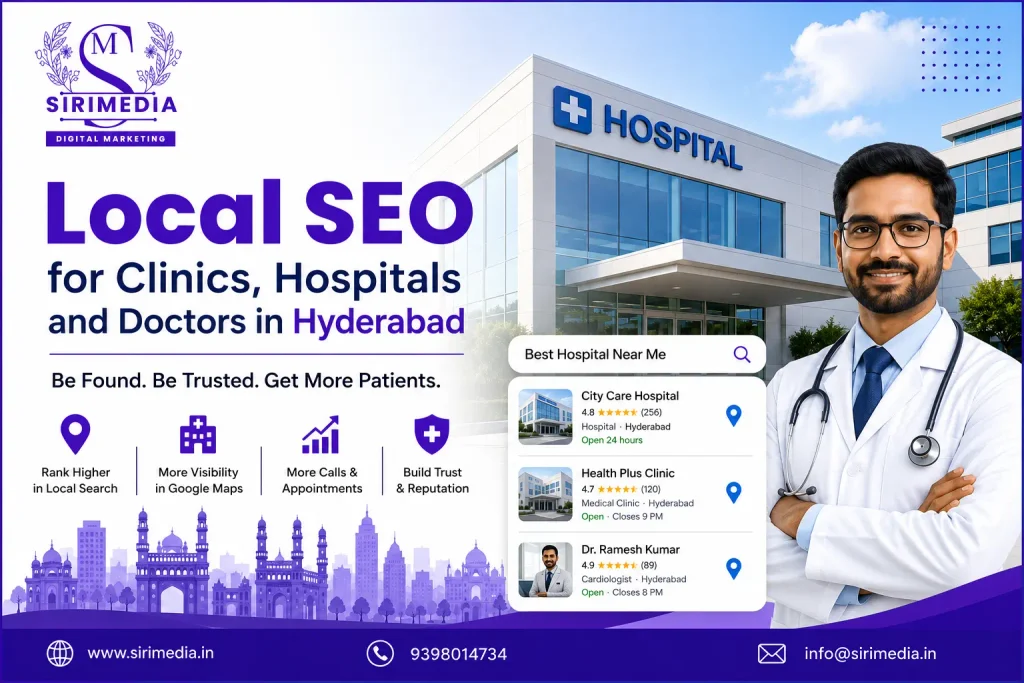
Local SEO for hospitals has become an important digital marketing strategy for healthcare businesses that want to attract patients from Hyderabad and its surrounding areas. When someone needs a doctor, clinic, diagnostic centre, or hospital, the search often begins online with a phrase such as “best hospital near me”, “cardiologist in Hyderabad”, “dentist in Miyapur”, or “IVF clinic near me”. These searches are different from general information searches because the person may already have a strong intention to contact a healthcare provider. That makes local visibility incredibly valuable for clinics and hospitals competing in a crowded city like Hyderabad. A healthcare business can have experienced doctors, modern facilities, and excellent patient care, but if potential patients cannot find it when they search, those advantages may remain invisible online. Healthcare SEO Hyderabad strategies, therefore, need to connect medical expertise with local search intent, trustworthy content, accurate business information, and a convenient patient experience. Google states that local results are primarily influenced by relevance, distance, and prominence, which means healthcare businesses should build a complete and accurate local presence rather than rely on keyword repetition alone.
Why Local SEO for Hospitals Matters in Hyderabad
Local SEO for hospitals matters because healthcare decisions are often closely connected to geography. A patient searching for emergency care, a specialist consultation, diagnostic testing, maternity services, dental treatment, or a routine check-up usually wants a provider they can realistically reach. Hyderabad is a large and geographically diverse city, so someone living in Miyapur may not consider a clinic in LB Nagar equally convenient, while a patient working around Hitech City may prioritise hospitals in Gachibowli, Kondapur, Madhapur, or nearby areas. This creates an opportunity for healthcare businesses to build visibility around genuine service areas instead of attempting to rank for one broad phrase such as “hospital in Hyderabad”. Google explains that distance is one of the main factors used for local results, alongside relevance and prominence. A practical local SEO strategy, therefore, needs to communicate exactly what the healthcare organisation offers, where it operates, which specialities it provides, and how patients can contact it. When these signals are consistent across the website and business profile, search engines have clearer information to work with, and patients get a much better experience.
How Patients Search for Healthcare Services Locally
Healthcare searches are rarely limited to one generic keyword, and understanding this behaviour is essential when creating an SEO strategy. A person may first search for “orthopaedic doctor near me”, then compare several doctors, visit a hospital website, check reviews, look at the location on Google Maps, and finally call the clinic. Another person may search directly for “best skin specialist in Banjara Hills” because the location and speciality are already known. These different searches represent different stages of decision-making, so the website needs content that answers informational questions as well as pages designed for high-intent searches. A clinic should consider keywords around specialities, treatments, doctors, neighbourhoods, facilities, and appointment intent rather than building its entire strategy around one phrase. For example, a dental clinic might target “dentist in Miyapur”, “root canal treatment in Hyderabad”, and “dental clinic near Kukatpally”, while a cardiology hospital could focus on “cardiologist in Hyderabad”, “cardiology hospital near me”, and relevant treatment-related searches. The goal is not to force every keyword into every page; it is to create useful pages that naturally satisfy the specific needs behind those searches.
Healthcare SEO Hyderabad and the Changing Patient Journey
Healthcare SEO Hyderabad requires a patient-first approach because people researching medical services usually need more than a business name and telephone number. Before contacting a provider, patients may want to understand the doctor’s qualifications, treatment options, hospital facilities, location, appointment process, and what type of specialist they should consult. Search engines increasingly have access to information from websites, business profiles, users, and other sources, so maintaining accurate information across the digital ecosystem is important. Google explains that Business Profile information can be combined with information from public web content, third parties, users, and business owners to provide local information. This means healthcare SEO should not be treated as a collection of isolated website tricks. Your website, Google Business Profile, doctor pages, reviews, local citations, and other legitimate online references should tell a consistent story about the healthcare organisation. When someone discovers a hospital through search, every subsequent touchpoint should reinforce the same message: what the organisation does, where it is located, what services it provides, and how the patient can take the next step.
Search Intent Behind Medical Keywords
Search intent is one of the most useful concepts for healthcare SEO because two keywords that look similar can represent completely different needs. Someone searching “what is cataract surgery” is primarily looking for information, while someone searching “cataract surgeon in Hyderabad” is much closer to finding a healthcare provider. Similarly, “symptoms of thyroid problems” is informational, whereas “endocrinologist in Hyderabad” has stronger local and commercial intent. A successful content strategy should accommodate both types of searches without turning educational articles into aggressive advertisements. Informational content can build visibility and demonstrate expertise, while service pages and doctor pages can provide the information needed when someone is ready to make contact. Healthcare websites should also be particularly careful about accuracy because medical information can influence real-world decisions. Content should be reviewed appropriately, avoid unsupported claims, and clearly distinguish educational information from professional medical advice. Instead of chasing keywords simply because they have search volume, map each keyword to the page that can genuinely answer the user’s need.
Google Business Profile for Hospitals and Clinics
A well-managed Google Business Profile is one of the most important components of local SEO for a healthcare organisation with an eligible physical presence. It functions like a digital shopfront on Google Search and Maps, giving potential patients access to information such as the organisation’s name, location, contact details, hours, website, photos, and reviews. Google recommends keeping business information complete and accurate because this helps customers understand what a business does, where it is located, and when it can be visited. For a hospital or clinic, accuracy becomes especially important because patients may be travelling specifically for an appointment or treatment. A wrong phone number, outdated address, incorrect opening hours, or misleading business category can create frustration before the patient even reaches the website. Healthcare organisations should also follow Google’s Business Profile rules rather than trying to manipulate the listing with keyword-stuffed names or inaccurate locations. Google’s guidelines state that businesses should represent themselves consistently as they are recognised in the real world and use accurate addresses and categories.
Optimizing Business Information for Local Visibility
Optimisation should begin with the fundamentals rather than complicated tactics. The hospital or clinic name should accurately reflect the real-world business name, the physical address should be correct, the telephone number should connect patients to the appropriate location, and the website should represent that specific business. Google advises businesses to choose the fewest categories necessary to describe their core business accurately rather than creating an exaggerated collection of categories. Healthcare organisations should also upload authentic photographs that help patients recognise the location, such as the exterior, reception area, facilities, and appropriate team or service images. Service information should be maintained where applicable, and opening hours should be updated when schedules change. For doctors operating as individual practitioners, Google also has specific guidance: eligible public-facing practitioners may have their own dedicated Business Profile when they can be contacted directly at the verified location during stated hours. These details may sound basic, but local SEO often begins with getting the basics right and keeping them accurate over time.
Local SEO for Hospitals in Google Maps
Local SEO for hospitals should pay particular attention to Google Maps because patients often use Maps as a discovery and decision-making tool. A hospital can appear for searches involving its name, category, speciality, neighbourhood, or proximity, but visibility is not guaranteed simply because the profile exists. Google says local results are mainly based on relevance, distance, and prominence, with prominence influenced by factors such as how well-known a business is and information including links and reviews. This gives healthcare businesses three broad areas to work on. Relevance means accurately explaining what the organisation offers; distance is largely determined by the searcher’s location and the business location; prominence relates to the organisation’s overall visibility and reputation. A business cannot simply pay Google to receive a better local ranking, according to Google’s own guidance. The practical lesson is straightforward: instead of looking for a shortcut, healthcare marketers should build an accurate, trusted, locally relevant digital presence.
Relevance, Distance and Prominence
These three concepts can help explain why a hospital may rank well for one local query but not another. Relevance improves when the business profile and website clearly describe the hospital’s actual specialities, services, and location. Distance means a nearby searcher may receive different results from someone searching several kilometres away, so no ethical SEO strategy can guarantee one fixed Maps position for every person in Hyderabad. Prominence is connected to the overall strength and recognition of the business, including legitimate online references and reviews. Google also recommends responding to reviews and adding photos and videos to Business Profiles as part of improving local visibility and helping customers understand the business. For hospitals, these activities should be handled professionally and with patient privacy in mind. The objective is not to manufacture popularity but to make the organisation’s genuine presence easier for search engines and patients to understand.
Local SEO for Doctors in Hyderabad
Doctors have a unique opportunity in local search because patients frequently search for specialists by name, medical speciality, and location. A doctor page can target searches such as cardiologist in Hyderabad, dermatologist in Banjara Hills, orthopaedic doctor in Kondapur, gynaecologist in Kukatpally, paediatrician in Gachibowli, or dentist in Miyapur, provided those locations and services genuinely apply. The page should not simply repeat the doctor’s name and keyword dozens of times. Instead, it should provide meaningful information about qualifications, speciality, clinical interests, consultation locations, experience, services, appointment procedures, and the hospital or clinic affiliation where relevant. Google specifically recognises individual practitioners as a category that can have dedicated business profiles under certain conditions, including being public-facing and directly contactable at the verified location during stated hours. A strong doctor SEO strategy, therefore, combines an optimised practitioner page with accurate local business information, useful healthcare content, and a trustworthy reputation. The aim is to help patients make informed choices rather than simply generate rankings.
Location-Based Keyword Research for Healthcare
Keyword research for Hyderabad healthcare businesses should begin with the actual services and specialities offered, followed by geographic modifiers and patient intent. A hospital might organise keywords into groups such as ‘multispecialty hospital’, ‘cardiology’, ‘orthopaedics’, ‘paediatrics’, ‘maternity’, ’emergency care’, ‘diagnostics’, or other relevant departments. Each group can then be connected with genuine local phrases such as ‘Hyderabad’, ‘Gachibowli’, ‘Kondapur’, ‘Miyapur’, ‘Kukatpally’, ‘Madhapur’, ‘Banjara Hills’, ‘Jubilee Hills’, or ‘Secunderabad’ where appropriate. The important word here is genuine: a healthcare provider should not create location pages for neighbourhoods it does not actually serve merely because those keywords appear attractive. Google’s guidelines emphasise accurate business representation and precise location information. Keyword research should also include conversational searches and question-based queries because patients do not always search using formal medical terminology. Someone may type “heart doctor near me” rather than “cardiologist”, and an effective SEO strategy should understand the language patients actually use.
Hyderabad Neighborhood Keywords
Hyderabad’s size makes neighbourhood-level SEO particularly valuable when it reflects real patient catchments. A clinic near Miyapur may naturally serve patients from nearby parts of the northwest, while a hospital in Gachibowli may attract people working or living around Hitech City, Kondapur, and surrounding areas. Rather than publishing dozens of nearly identical pages, create a smaller number of genuinely useful location pages where there is a real business reason to target those areas. Each page can explain the services available, directions, nearby landmarks, consultation information, and other useful local details. The content should be written for people first, with keywords appearing naturally in headings and copy. Location keywords can also be integrated into title tags, metadata, internal links, image descriptions where appropriate, and relevant service content. The result should feel like a useful local resource rather than a page created solely for search engines.
Build Dedicated Hospital and Clinic Service Pages
A common problem with healthcare websites is that every service is placed on one generic “Services” page. This limits the website’s ability to answer specific searches because search engines and patients have to navigate a broad collection of unrelated information. A stronger structure gives important specialities and treatments their own pages, provided each page contains substantial and accurate information. For example, a multispecialty hospital could have dedicated pages for cardiology, orthopaedics, gynaecology, paediatrics, ENT, ophthalmology, diagnostics, and other genuine departments. Each page can explain what the department provides, who may need the service, which doctors are associated with it, what facilities are available, and how patients can request an appointment. These pages can then be connected to relevant doctor profiles and educational articles through internal links. This creates a logical information architecture in which the hospital homepage establishes the overall organisation, speciality pages explain services, doctor pages introduce practitioners, and educational content answers patient questions.
Create Doctor Profile Pages That Build Trust
A doctor profile should function as more than an online résumé. It should answer the questions a patient is likely to have before making an appointment: Who is this doctor? What do they specialise in? What qualifications do they have? Where do they consult? What services do they provide? How can I book an appointment? Clear and accurate answers can make a major difference to the patient’s experience. Include relevant qualifications, professional experience, areas of expertise, consultation locations, and appropriate appointment information. Where medical claims or educational material are included, ensure the content is accurate and appropriately reviewed. A profile can also connect to relevant speciality pages and educational articles, creating a useful internal-linking network. If the doctor is eligible for an individual practitioner business profile, the online information should remain consistent with the real-world practice. Google’s practitioner guidance specifically addresses how individual professionals, such as doctors, can be represented on business profiles.
Healthcare Content Strategy for Local Search
Healthcare content can attract people at different stages of the patient journey, but it needs to be created with more care than generic SEO content. Instead of producing dozens of thin articles simply because keywords are available, build content around questions that patients genuinely ask. A cardiology department might publish educational articles about when someone should seek cardiac evaluation, while a dental clinic could explain common reasons for tooth sensitivity or what to expect from a dental consultation. Local relevance can be introduced when it is genuinely useful, such as explaining how to prepare for an appointment at a particular facility or what services are available at a specific location. Content should not promise guaranteed outcomes or use exaggerated claims such as “100% cure” or “best doctor for everyone”. It should provide clear educational information and encourage readers to consult qualified professionals for individual medical concerns. This approach can support both search visibility and patient trust.
Online Reviews and Healthcare Reputation Management
Reviews can influence how prospective patients perceive a hospital or clinic, and Google confirms that reviews appear alongside Business Profiles in Maps and Search. Healthcare organisations should encourage genuine patients to share honest experiences without offering incentives in exchange for positive reviews. Google’s guidance explicitly says that offering free or discounted goods or services in exchange for reviews, changes, or removal of negative reviews is prohibited. A responsible review strategy therefore focuses on making the process easy rather than manipulating the outcome. Clinics can provide patients with a review link or QR code after an appropriate interaction, while staff can politely remind satisfied and dissatisfied patients alike that honest feedback is welcome. Responses should remain professional and protect patient privacy, especially when responding to complaints. Google recommends keeping responses clear, helpful, and polite and warns businesses against sharing private information in public replies.
Local Citations and Healthcare Directories
Local citations are online references to a healthcare organisation that may contain its name, address, telephone number, website, or other business information. Relevant healthcare directories, professional organisations, local publications, and reputable business directories can contribute to a consistent online presence. The key is quality and accuracy rather than submitting the hospital to every directory available on the internet. If the same organisation is represented with several different addresses, phone numbers, or names, patients may become confused and search engines may receive conflicting signals. Google’s Business Profile guidance emphasises accurate business information and consistent real-world representation. Healthcare marketers should therefore audit existing citations before creating new ones, correct outdated information, and remove or update inaccurate listings where possible. This is particularly important for hospitals that have moved, clinics that have changed phone numbers, or doctors who now practise at a different location.
Technical SEO for Medical Websites
Technical SEO creates the foundation on which local content can perform. A healthcare website should be crawlable, secure, mobile-friendly, logically structured, and reasonably fast. Important pages should not be blocked accidentally, broken links should be fixed, duplicate pages should be controlled, and XML sitemaps should be maintained properly. Page titles and headings should clearly describe the content rather than relying on vague labels such as “Services” or “About”. Images should be optimised without damaging visual quality, and important appointment information should remain accessible to both users and search engines. Technical SEO also includes checking whether the website works correctly on different devices, because a patient searching from a smartphone may immediately leave a site that is difficult to navigate. The technical foundation should support the content rather than distract from it. A beautiful website that loads slowly or makes appointment information difficult to find can lose valuable opportunities even if its keyword strategy is strong.
Mobile SEO and Appointment Conversion
Mobile SEO is particularly important for healthcare because patients often search when they are away from a desktop computer. A person may search for a doctor while travelling, compare hospitals while commuting, or need a clinic’s phone number immediately. The mobile website should therefore make essential actions obvious: call the clinic, find the location, request an appointment, view consultation hours, and understand available services. Buttons should be easy to tap, forms should be short enough to complete comfortably, and important information should not be hidden beneath unnecessary design elements. The website should also provide a clear path from informational content to an appropriate next step. For example, an article about back pain could link naturally to an orthopaedic department or doctor profile without making the article feel like an advertisement. Local SEO is not only about generating impressions; it should help transform relevant search visibility into meaningful patient enquiries.
Internal Linking for Healthcare Websites
Internal linking is one of the simplest ways to improve the organisation of a healthcare website. Imagine the website as a hospital building: the homepage is the main entrance, speciality pages are departments, doctor profiles are consultation rooms, and educational articles are information desks. Visitors should be able to move between these areas without getting lost. A cardiology article can link to the cardiology department, which can link to cardiologists, and those doctor pages can link to appointment information. Similarly, a dental treatment article can connect to the dental service page and relevant dentist profiles. This structure helps users discover related information while also helping search engines understand relationships between pages. Anchor text should be descriptive and natural rather than repeatedly using the same keyword phrase. A well-planned internal linking system can also help important pages receive more contextual visibility without requiring excessive external link building.
Local Schema and Structured Data
Structured data can help search engines interpret information about a healthcare organisation and the content of individual pages when implemented accurately. Depending on the page and organisation, relevant structured data may describe an organisation, local business, medical professional, article, FAQ content, or other supported entities. The important principle is accuracy: structured data should represent information that is actually present and supported on the page. It should never be used to create fictional ratings, services, locations, or claims. Healthcare websites should also keep their visible content consistent with their structured data. When implemented correctly, structured data forms part of a broader technical SEO strategy rather than acting as a shortcut to higher rankings. It should be reviewed as the website changes, particularly when doctors join or leave a hospital, locations change, services are added, or opening hours are updated.
Ethical SEO for Healthcare Businesses
Healthcare SEO should always prioritise accuracy, transparency, and patient trust over aggressive ranking tactics. This is especially important because people may rely on medical information when making decisions about their health. A healthcare website should avoid fake reviews, fabricated credentials, misleading claims, keyword-stuffed business profile names, copied medical content, and artificial location pages. Google’s Business Profile policies require businesses to accurately represent their real-world locations and prohibit various forms of misleading or prohibited content. Ethical SEO may take more effort because it requires genuine content, accurate information, legitimate reputation building, and consistent maintenance, but it creates a much stronger foundation for long-term visibility. The objective should never be to make a clinic appear to be something it is not. Instead, SEO should make the real strengths of the organisation easier for patients to discover.
Measuring Local SEO Performance
A healthcare SEO campaign should be measured against business outcomes rather than rankings alone. Keyword positions can be useful, but they do not tell the complete story because local results can vary according to the searcher’s location, relevance, and other factors. Track organic website traffic, Google Business Profile visibility, phone calls, appointment enquiries, direction requests, branded searches, relevant keyword trends, and conversions from important landing pages. Review the performance of individual speciality pages to identify which services attract the strongest search interest. It is also useful to compare website engagement and enquiry quality rather than simply counting traffic. A thousand visits from people outside the hospital’s service area may be less valuable than a smaller number of highly relevant local visitors. Google notes that local rankings are influenced by relevance, distance, and prominence, so performance reporting should recognise that local visibility is inherently geographic.
Common Local SEO Mistakes Healthcare Businesses Make
One of the biggest mistakes is assuming that adding “Hyderabad” to every page will automatically improve rankings. Search engines need useful, relevant content and accurate business information, not endless keyword repetition. Another common mistake is creating multiple Google Business Profiles for one physical location or adding inaccurate locations to target more neighbourhoods; Google’s guidelines specifically address profile duplication and accurate location representation. Some clinics also neglect their doctor pages, leaving patients with little information about qualifications and specialities. Others publish blogs without connecting them to service pages, so the content generates little practical value. Review manipulation is another serious problem because Google prohibits incentivised review activity. Finally, many healthcare businesses measure success only through keyword rankings and ignore calls, appointment requests, and patient journeys. The better approach is to build a complete local ecosystem where search visibility, trustworthy information, user experience, and conversion work together.
90-Day Local SEO Strategy for Hyderabad Healthcare Businesses
A practical 90-day plan can turn local SEO from a vague marketing activity into a structured process. During the first month, focus on the foundation: audit the website, verify and optimise the Google Business Profile, review NAP information, research local keywords, identify important specialities, and map keywords to existing or new pages. During the second month, expand the content architecture by improving service pages, creating or updating doctor profiles, developing useful local content, strengthening internal links, and correcting important citation inconsistencies. During the third month, analyse performance and build authority through legitimate content promotion, relevant local mentions, review management, and ongoing technical improvements. Google recommends keeping Business Profile information complete and up to date, responding to reviews, and adding useful photos and videos. The strategy should then continue beyond the first 90 days because SEO is not a one-time activity. Search behaviour changes, competitors publish new content, doctors join or leave organisations, and healthcare services evolve. Consistent monitoring and improvement are what turn an initial SEO campaign into sustainable local visibility.
Conclusion: Build Sustainable Healthcare Visibility in Hyderabad
Local SEO for hospitals is ultimately about making it easier for the right patients to discover the right healthcare provider at the right moment. A strong strategy combines Google Business Profile optimisation, local keyword research, useful speciality pages, trustworthy doctor profiles, accurate healthcare content, genuine reviews, technical SEO, mobile usability, internal linking, structured data, and responsible reputation management. For clinics and hospitals in Hyderabad, neighbourhood-level relevance can be particularly valuable because patients often care about accessibility and travel distance as much as the service itself. Google confirms that local search visibility is influenced primarily by relevance, distance, and prominence, which means no legitimate strategy can promise a universal position for every searcher. Instead, healthcare businesses should focus on becoming the clearest, most useful, and most trustworthy answer for the searches they genuinely serve. When the website, Google Business Profile, doctor information, reviews, and local references all accurately communicate the same story, SEO becomes more than a traffic-generation tactic. It becomes a digital bridge between healthcare expertise and patients actively looking for help in Hyderabad.
FAQs
1. What is Local SEO for Hospitals?
Local SEO for hospitals is the process of improving a hospital’s visibility in location-based searches on Google Search and Google Maps. It involves optimising the business profile, website, service pages, doctor profiles, reviews, local content, citations, and technical elements so that patients can more easily discover relevant healthcare services in their area.
2. How can Healthcare SEO Hyderabad help a hospital?
Healthcare SEO Hyderabad can help hospitals attract relevant organic search traffic from patients looking for medical specialities and services in Hyderabad. A well-planned strategy can improve visibility for location and speciality searches, strengthen the hospital’s online presence, support Google Maps discovery, and make it easier for potential patients to find appointment and contact information.
3. Should doctors have separate SEO pages from the hospital?
Yes. Dedicated doctor profile pages can provide useful information about qualifications, specialities, experience, consultation locations, and appointment options. They can also target relevant searches involving the doctor’s name, speciality, and location while connecting naturally with the hospital’s speciality and service pages.
4. Are Google reviews important for a hospital’s local SEO?
Reviews are an important part of a healthcare business’s online reputation and can help prospective patients evaluate a provider. Google says reviews appear alongside Business Profiles in Search and Maps and recommends asking customers for genuine reviews and responding appropriately. Healthcare businesses should never buy, fabricate, or incentivize reviews.
5. How long does local SEO for hospitals take to show results?
There is no universal timeframe because local SEO performance depends on competition, website quality, existing authority, location, Business Profile health, content quality, and the search terms being targeted. New and improved visibility can develop gradually as Google processes information and the website builds relevance and prominence. A healthcare business should therefore treat SEO as an ongoing investment rather than expecting a guaranteed ranking within a fixed number of days.